
MBA CET 2026 Attempt 2 Result Discrepancy:
Score vs Percentile Confusion Explained
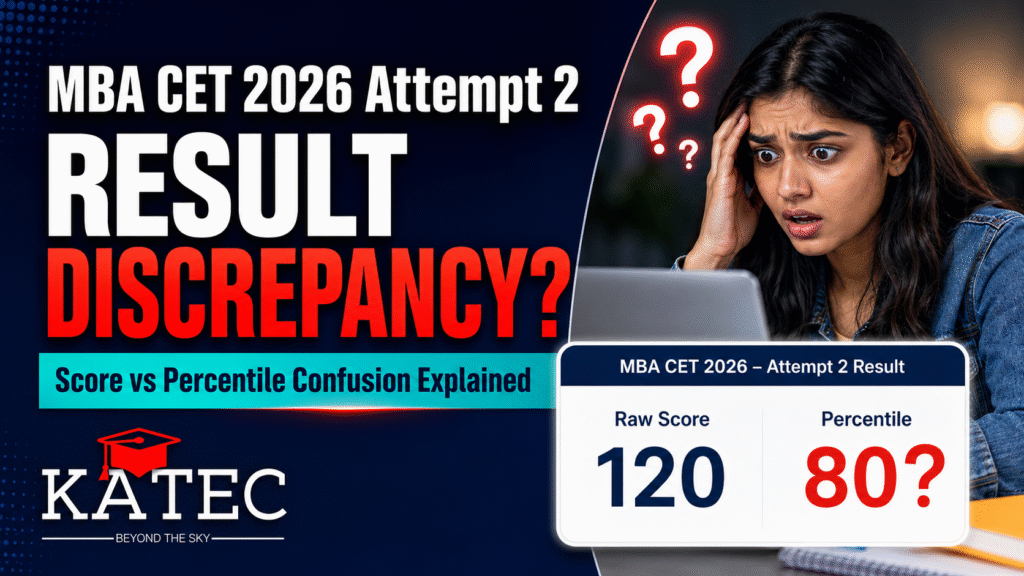
The MAH MBA/MMS CET 2026 Attempt 2 result has created serious confusion among many students. A number of candidates are reporting that their marks and percentiles are not matching the expected pattern, especially when compared with their Attempt 1 performance and the general score-vs-percentile trends of MBA CET.
At this stage, it is important to stay balanced. Students should not blindly believe rumours, but at the same time, genuine concerns should not be ignored. If a large number of students are observing an unusual difference between marks and percentile, the issue deserves proper clarification.
This blog explains what has happened, what was expected, what appears unusual, and what students should do now.
What Is the Main Issue in MBA CET 2026 Attempt 2 Result?
The main concern is simple:
Many students feel that the marks they scored in Attempt 2 should have resulted in a higher percentile, but the percentile shown in the result is much lower than expected.
Normally, percentile depends on relative performance. If a paper is easy and many students score high marks, then even a good score may not give a very high percentile. This is understandable.
However, the concern in MBA CET 2026 Attempt 2 is that the gap seems much larger than expected. Students are claiming that even after scoring reasonably good marks, their percentile has dropped sharply.
This has created doubt about whether the score-vs-percentile mapping, slot-wise comparison, or normalization process has affected some students more than expected.
What Was Expected?
In simple terms, students expected the following:
If Attempt 2 was tougher than Attempt 1, then a good raw score in Attempt 2 should ideally have resulted in a better percentile.
That is because in a tougher paper, average marks are usually lower. So, if a student scores well in a tougher slot, the percentile should generally improve.
But many students are reporting the opposite. They are saying that despite scoring well, their percentile has not increased as expected. In some cases, students are claiming that their percentile is surprisingly low compared with their raw score.
This is the reason students feel that the result pattern does not look normal.
Why Percentile Can Fall Even After Good Marks
Before jumping to conclusions, students must understand one important point.
MBA CET percentile is not the same as percentage. It does not only depend on your marks. It depends on how many students performed below you.
For example, if many students in the same slot scored very high marks, then even a good score may lead to a lower percentile than expected.
So, technically, a low percentile with good marks is possible if the paper was very easy or if many candidates performed extremely well.
However, the current concern is not just that percentile is lower. The concern is that the difference appears too severe and unexpected, especially because many students felt Attempt 2 was not easier than Attempt 1.
Was Attempt 2 Easier or Tougher?
Based on student feedback, Attempt 2 was not considered extremely easy by many candidates. In fact, several students felt that Attempt 2 was slightly tougher or at least not easier than Attempt 1.
This is where the confusion begins.
If Attempt 2 was actually tougher, then a strong score should ideally have produced a better percentile. But if the percentile is still much lower, students naturally start questioning the result calculation.
This does not automatically prove an error, but it definitely creates a need for transparency.
Is Normalization the Possible Reason?
One possible explanation could be normalization.
When an exam is conducted in multiple slots or attempts, authorities may use normalization to adjust for differences in difficulty level. The purpose of normalization is to make the result fair for students across different sessions.
However, students are worried that if normalization was applied too severely, it may have negatively affected their percentiles.
There is also a possibility that because fewer students appeared for Attempt 2 compared with Attempt 1, the score-vs-percentile conversion may have behaved differently. If the candidate pool was smaller or unusually competitive, percentiles could shift sharply.
But the real problem is that students do not have access to clear slot-wise data. Without transparent data, students are left guessing.
Why Students Are Asking for Clarification
Students are not simply asking for marks to be increased. They are asking for clarity.
The major questions are:
- Was normalization applied between Attempt 1 and Attempt 2?
- Was normalization applied slot-wise within Attempt 2?
- What was the highest score in each slot?
- What was the average score in each slot?
- How many students appeared in each slot?
- What was the score-vs-percentile mapping for each slot?
- Were there any technical errors in result processing?
- Was the percentile calculated only within the slot or after a broader normalization process?
These are reasonable questions because MBA CET scores directly affect admissions to colleges through the CAP round process.
What Is Officially Confirmed So Far?
As per the official objection redressal notice for MAH MBA/MMS CET 2026 Attempt 2, the exam was conducted on 09 May 2026 in two sessions.
A total of 29 unique objections were raised. Out of these, 6 objections were accepted as valid.
In the morning session, there was one answer-key update and one bonus-mark question.
In the evening session, there was one answer-key update and three bonus-mark questions.
This means that official corrections were made after the objection process. However, as of now, there has been no official clarification specifically accepting any result anomaly or percentile calculation error.
Is This Type of Issue New?
No. MBA CET has seen answer-key and objection-related issues in the past as well.
In MBA CET 2025, a large number of objections were raised by students. After review, grace marks were awarded for multiple erroneous questions across sessions.
So, MBA CET result-related concerns are not completely new. The difference this year is that the present concern is not only about wrong questions or answer-key errors. It is more about score-vs-percentile mapping and whether the final percentile calculation reflects student performance correctly.
Should Students Use the Word “Scam”?
Students should be careful with language.
At this stage, it is better to avoid words like “scam” unless there is official proof. A more appropriate term would be:
- result discrepancy
- score-vs-percentile anomaly
- unexpected percentile variation
- request for clarification
- possible normalization issue
Using responsible language makes the complaint stronger and more acceptable.
The focus should be on asking for transparency, not spreading panic.
What Can Students Do Now?
Students can take the following steps:
1. Save All Proofs
Students should save:
- scorecard
- response sheet, if available
- answer key details
- objection-related documents
- Attempt 1 and Attempt 2 score details
- screenshots of marks and percentile
- slot details
Do not delete any exam-related data.
2. Compare Attempt 1 and Attempt 2 Performance
Students who appeared for both attempts should compare:
- Attempt 1 percentile
- Attempt 2 percentile
- Attempt 2 raw score
- paper difficulty perception
- slot details
If a student has clearly performed better in Attempt 2 but received an unexpectedly lower percentile, that case should be documented properly.
3. Submit a Formal Request to CET Cell
Students can write to CET Cell and request clarification regarding score-vs-percentile mapping.
The request should be polite, factual, and data-based.
Students can ask CET Cell to release:
- slot-wise number of candidates
- highest score per slot
- average score per slot
- score-vs-percentile mapping
- normalization formula, if used
- clarification on whether Attempt 1 and Attempt 2 were normalized together
4. Avoid Blindly Depending on Social Media Data
Student-reported data can be useful to identify patterns, but it is not official proof.
Many screenshots and score claims circulate on WhatsApp, Telegram, Reddit, and Instagram. Some may be genuine, but some may be incomplete or inaccurate.
So, students should use social media data only as an indicator, not as final evidence
5. Do Not Pause CAP Round Preparation
This is extremely important.
Even if students are expecting a correction or clarification, they should not stop preparing for the CAP round.
In most cases, admission timelines move ahead. If students wait blindly and no action is taken, they may lose valuable time.
So, the right approach is:
Raise the issue officially, but continue CAP planning side by side.
Will Student Complaints Make a Difference?
Honestly, it depends.
If only a few students complain informally on social media, the chances of action may be low.
But if a large number of students submit structured complaints with proper data, CET Cell may be more likely to issue a clarification.
Students should understand that the most realistic outcome may not necessarily be a revised result. The more realistic possibilities are:
- CET Cell may issue a clarification.
- CET Cell may explain the normalization method.
- CET Cell may release additional data.
- CET Cell may review cases if there is a genuine technical issue.
- CET Cell may take no major corrective action.
So, students should hope for clarification, but they should not depend entirely on result revision.
What If No Action Is Taken?
If no action is taken, students must immediately shift focus to admission strategy.
The next stage is CAP round planning.
Students should start working on:
- college list
- category-wise cutoff analysis
- realistic options based on percentile
- document readiness
- preference form strategy
- backup colleges
- institutional-level rounds
- GD-PI preparation, wherever applicable
Even if the percentile is lower than expected, the admission game is not over. A smart CAP strategy can still help students get the best possible college within their percentile range.
What Should Students Focus on Going Ahead?
Students should divide their plan into two tracks.
Track 1: Raise the Concern
Students who genuinely feel affected should:
- collect data
- submit a formal complaint
- ask for transparency
- coordinate with other genuine students
- avoid emotional or abusive language
- keep the issue factual
Track 2: Continue Admission Planning
At the same time, students should:
- shortlist colleges
- check previous year cutoffs
- prepare documents
- understand CAP rounds
- prepare backup options
- take expert guidance if confused
Both tracks must run together.
Do not make the mistake of waiting for a correction and ignoring CAP planning.
KATEC’s View
At KATEC, our view is simple:
Students deserve transparency, but students also need practical guidance.
If the score-vs-percentile mapping appears unusual, students have every right to ask for clarification. At the same time, students should not panic, spread rumours, or pause their admission planning.
The best approach is data-based action.
Collect your score details. Compare them properly. Raise the concern through official channels. But also start planning your CAP round strategy immediately
Final Advice for Students
Do not panic.
Do not blindly believe rumours.
Do not ignore genuine discrepancies.
Do not wait passively.
Take action, but take action smartly.
If you feel your MBA CET 2026 Attempt 2 result does not match your expected performance, save your proof, submit a formal request for clarification, and continue your CAP round planning without delay.
Your percentile may not be in your control now, but your admission strategy is still in your control.
For MBA CET 2026 CAP round guidance, college selection, cutoff analysis, and admission strategy, students can connect with KATEC.